



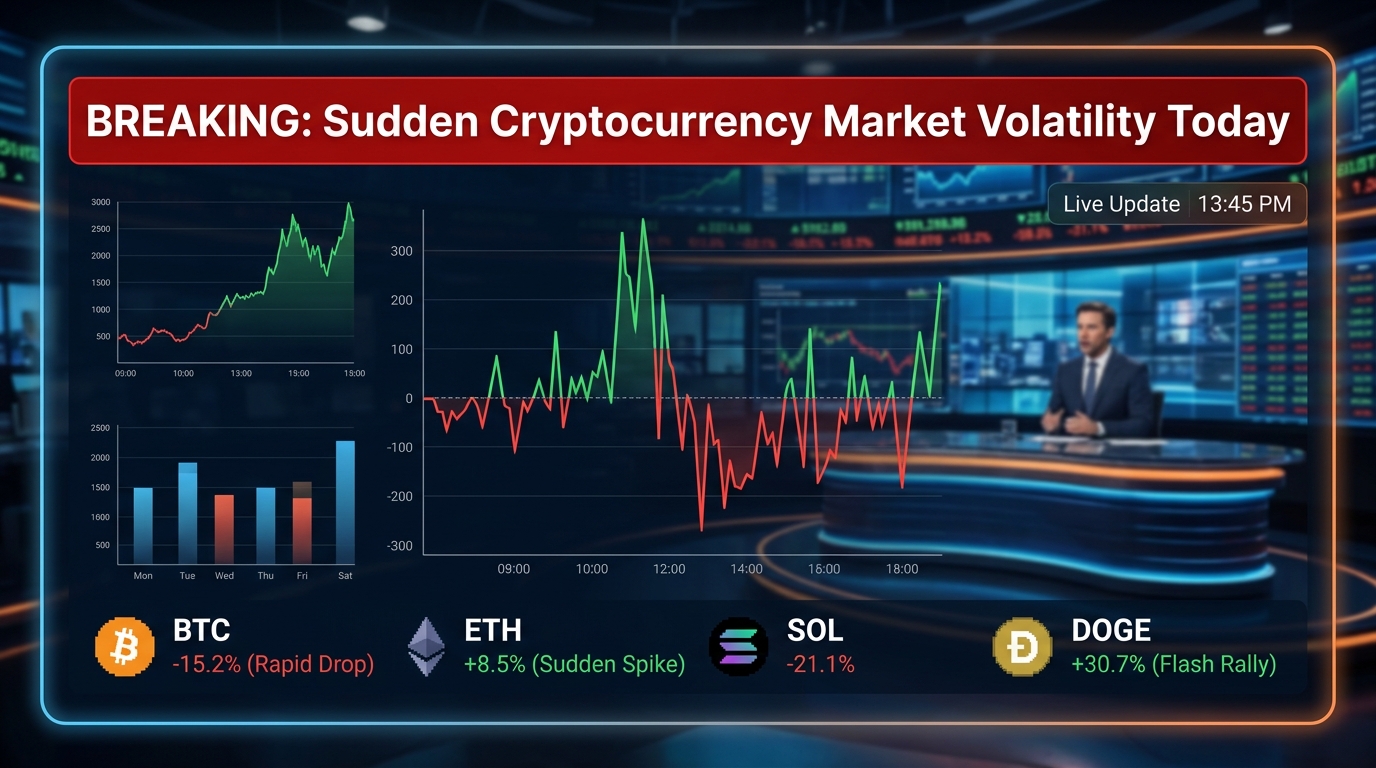
Cryptocurrency markets are experiencing sharp price volatility today as traders react to rapid shifts in liquidity, regulatory expectations, and global macroeconomic signals. Sudden price swings across major digital assets reflect heightened uncertainty in investor sentiment, with both institutional and retail participants adjusting positions quickly in response to breaking news and market momentum changes.
Market-Wide Crypto Volatility Surge
Rapid Price Fluctuation Patterns
Cryptocurrency prices are showing rapid fluctuation patterns as buy and sell pressure intensifies across exchanges. Sudden spikes and drops are being driven by automated trading systems and leveraged positions, creating unstable conditions that amplify short-term volatility across major digital assets like Bitcoin and Ethereum.
Liquidity Stress in Exchanges
Liquidity stress across cryptocurrency exchanges is contributing to wider bid-ask spreads and inconsistent pricing. Reduced liquidity during high trading activity makes it harder to execute large orders smoothly, increasing volatility and causing sharper price movements in both spot and derivatives markets.
Derivatives Market Liquidations
Large-scale liquidations in futures and derivatives markets are accelerating price swings as leveraged positions are forcibly closed. These cascading liquidations intensify downward or upward momentum, depending on market direction, and often lead to sudden, unpredictable market reversals in short time frames.
Retail Investor Reaction
Retail investors are reacting quickly to price changes, often driven by social media trends and market fear or excitement. This emotional trading behavior increases volatility as small traders enter and exit positions rapidly, adding further instability to already sensitive market conditions.
Whale Activity Influence
Large holders, commonly known as whales, are influencing price direction through significant buy or sell orders. Their movements can trigger broader market reactions, as automated trading systems and smaller investors respond quickly to sudden liquidity changes.
Bitcoin Price Movement Dynamics
Institutional Trading Impact
Institutional trading activity in Bitcoin is contributing to short-term volatility as large funds rebalance portfolios. These trades often involve high volumes, which can significantly impact price direction and create ripple effects across the broader cryptocurrency market.
ETF Flow Variations
Exchange-traded fund inflows and outflows are influencing Bitcoin demand levels. Sudden changes in ETF participation can create immediate price pressure, reflecting investor confidence or caution in regulated crypto investment products.
Halving Cycle Sentiment
Market sentiment around Bitcoin halving cycles continues to influence trading behavior. Expectations of reduced supply often drive speculative activity, which can amplify volatility even before actual supply changes take effect.
Mining Profitability Changes
Fluctuations in mining profitability due to energy costs and network difficulty are affecting Bitcoin supply dynamics. When profitability declines, miners may sell holdings, adding pressure to market prices and increasing volatility.
Macro Economic Correlation
Bitcoin is increasingly correlated with global macroeconomic indicators such as interest rates and inflation data. Changes in traditional financial markets are now directly impacting crypto price movements and investor sentiment.
Altcoin Market Instability
Ethereum Network Activity
Ethereum price volatility is linked to network usage, DeFi activity, and gas fee fluctuations. Increased demand for blockchain transactions can drive price spikes, while reduced activity can lead to corrections.
Meme Coin Speculation
Meme coins are experiencing extreme volatility driven by social media hype and speculative trading. These assets often lack strong fundamentals, making them highly sensitive to sudden sentiment shifts.
Layer 1 Competition Pressure
Competing blockchain networks are influencing altcoin performance as investors rotate capital between ecosystems. Market share expectations in scalability and adoption are causing frequent price adjustments.
DeFi Token Liquidation Risks
DeFi tokens are facing volatility due to liquidation risks in lending protocols. Collateral value drops can trigger cascading liquidations, amplifying price instability across related assets.
Cross Chain Capital Flows
Capital movement between blockchain ecosystems is creating uneven liquidity distribution. Investors shifting funds across chains contribute to unpredictable price behavior in smaller altcoins.
Regulatory and Policy Uncertainty
Government Policy Announcements
Uncertainty around government regulations is a major driver of crypto volatility. New policy announcements or rumors can rapidly shift investor sentiment and trigger market-wide reactions.
Exchange Compliance Pressure
Increased compliance requirements for exchanges are affecting trading volumes and liquidity. Regulatory scrutiny often leads to temporary disruptions in market stability.
Taxation Framework Changes
Changes in crypto taxation policies influence investor behavior, particularly among institutional participants. Tax uncertainty can lead to short-term selling pressure and market hesitation.
Global Coordination Efforts
International coordination on cryptocurrency regulation is still evolving. Lack of uniform rules across countries contributes to fragmented market behavior and volatility.
Stablecoin Regulation Concerns
Regulatory attention on stablecoins is impacting market confidence. Since stablecoins provide liquidity for trading, any uncertainty around them can ripple across the entire crypto ecosystem.
Trading Technology and Automation Effects
Algorithmic Trading Systems
Algorithmic trading systems are amplifying volatility by reacting instantly to price movements and market signals. These systems can accelerate both upward and downward trends within seconds.
High Frequency Trading Impact
High frequency trading firms are contributing to rapid price changes through microsecond-level transactions. Their activity increases liquidity but also intensifies short-term volatility.
Exchange Matching Engine Load
High trading volumes can strain exchange infrastructure, causing delays or mismatched pricing. Technical pressure on systems sometimes worsens volatility during peak activity.
API Driven Trading Bots
Retail and institutional trading bots using APIs are reacting automatically to market changes. These automated responses often reinforce momentum-driven price swings.
Arbitrage Opportunity Shifts
Differences in prices across exchanges create arbitrage opportunities, which are quickly exploited. While this improves efficiency, it also contributes to fast-moving price corrections.
Investor Sentiment and Market Psychology
Fear and Greed Index Movement
Market sentiment indicators show rapid shifts between fear and greed, influencing trading decisions. Emotional extremes often align with sharp price movements.
Social Media Influence
Social media platforms are playing a major role in shaping crypto sentiment. Viral posts and influencer commentary can trigger sudden buying or selling activity.
News Driven Speculation
Breaking news events significantly impact crypto markets due to their sensitivity to uncertainty. Traders often react before full information is confirmed.
FOMO and Panic Selling Cycles
Fear of missing out and panic selling cycles are intensifying volatility. These psychological factors lead to exaggerated market reactions in both directions.
Retail Trading Momentum
Retail traders following momentum strategies contribute to short-term price spikes and drops. Collective behavior amplifies existing market trends.
Future Outlook for Crypto Market Stability
Institutional Adoption Trends
Growing institutional adoption may reduce long-term volatility by increasing liquidity depth and stabilizing demand across major cryptocurrencies.
Regulatory Clarity Development
Improved regulatory clarity is expected to create more predictable market conditions, reducing uncertainty-driven price swings.
Market Infrastructure Maturity
Advancements in exchange infrastructure and trading systems may help reduce technical disruptions and improve price stability.
Stablecoin Ecosystem Strengthening
Stronger and more regulated stablecoin systems could enhance liquidity stability and reduce extreme market fluctuations.
Long Term Market Integration
As cryptocurrencies become more integrated with traditional finance, volatility may gradually decrease due to broader participation and risk diversification.
What causes sudden crypto volatility
Sudden volatility is caused by liquidity shifts, news events, leverage trading, and investor sentiment changes.
Are crypto markets more volatile than stocks
Yes, cryptocurrencies are generally more volatile due to lower regulation and higher speculative trading.
How do liquidations affect prices
Liquidations force large sell-offs or buy-ins, amplifying price movements quickly.
Do regulations reduce crypto volatility
Over time, clearer regulations can reduce uncertainty and stabilize markets.
Will crypto volatility decrease in future
Yes, increased institutional adoption and market maturity may reduce extreme volatility.
Cryptocurrency markets remain highly dynamic as sudden volatility reflects shifting liquidity, investor psychology, and global economic influences. While short-term instability continues, long-term trends point toward greater institutional involvement and improved market structure. As regulation and infrastructure evolve, the crypto ecosystem may gradually stabilize, but rapid price movements will likely remain a defining feature of digital asset trading.
